 Total Digital Security
5 min read
What Is a VPN and Do You Actually Need One?
A VPN (Virtual Private Network) is a tool that encrypts your internet traffic and hides your activity from anyone who might be watching on the same...
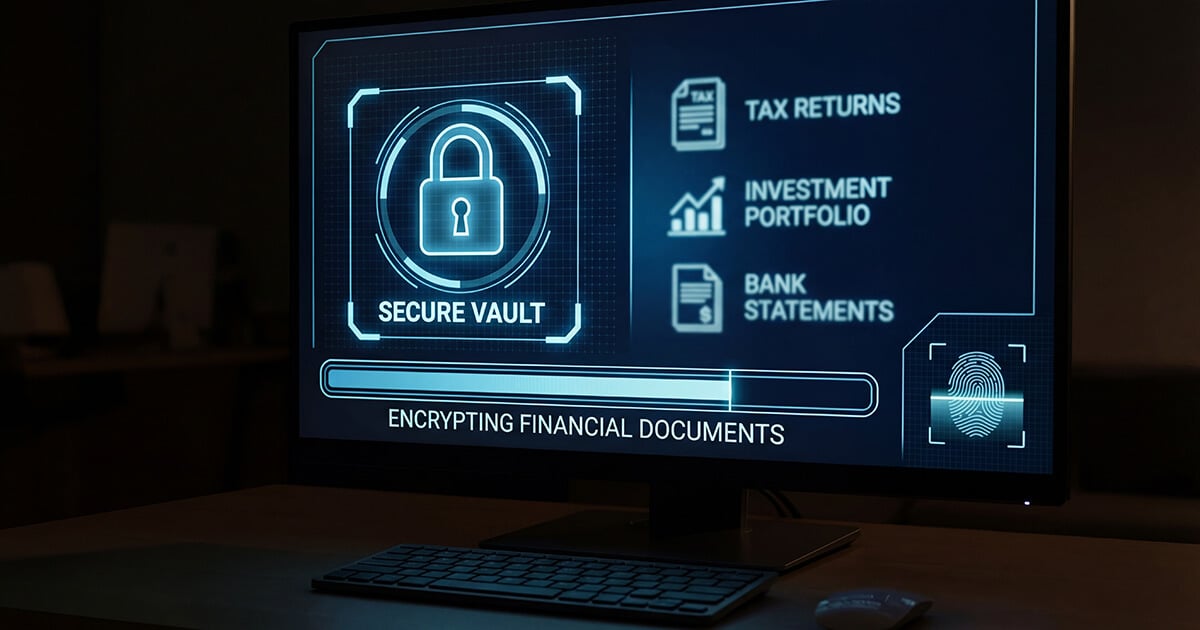
Your financial advisor works hard to protect your investments. They research. They diversify. They monitor markets. They have teams, systems, and compliance structures all designed to safeguard what you’ve worked to build.
But there’s a gap in that protection that almost nobody talks about — and it may be sitting in your inbox right now.
Think about the last time you emailed your financial advisor. Maybe it was about a distribution. A rebalancing decision. A new account you wanted to open. Your tax documents. Your estate planning details.
That communication almost certainly contained sensitive financial information. Account numbers. Balances. Personal identifiers. The kind of details that paint a complete picture of your financial life.
Now ask yourself: where did that email land on your end?
For most people, the answer is a free inbox — Gmail, Yahoo, AOL, or a similar platform. And while your advisor’s firm almost certainly has enterprise-level security protecting their systems, your inbox likely does not.
The weakest link in a financial communication is rarely the bank or the advisor. It’s the client’s unprotected inbox on the other end.
This isn’t a hypothetical risk. Financial account breaches consistently trace back to the client side, not the institution. Hackers don’t need to break into your bank’s systems when they can access your personal email and find years of statements, correspondence, and account details waiting there.
And it doesn’t stop at reading your emails. Once an attacker has access to your inbox, they can use it to reset passwords on your financial accounts, intercept future correspondence, and impersonate you in ways that are extremely difficult to detect.
AI has made this significantly worse. Attackers can now craft messages that perfectly mimic your advisor’s writing style, reference real account details, and create urgency around transactions that feel entirely legitimate. If your inbox is already compromised, they have everything they need to do this convincingly.
If you share this newsletter with clients — and we encourage you to — here’s the honest conversation worth having with them:
Your firm protects your systems. Your IT department monitors your network. But every email you send to a client lands in an inbox you have no visibility into and no control over. If that inbox is unprotected, the information you sent is unprotected.
This isn’t a reflection on your practice. It’s a gap in the system that most clients don’t know exists — until something goes wrong.
Protecting financial communications isn’t complicated once you know what to address. The starting points are straightforward:
None of this requires becoming a cybersecurity expert. It requires having the right partner who’s already thought through all of it — and can put the right pieces in place without turning your life upside down.
Your advisor asks you regularly about your financial health. It might be worth asking yourself about your digital health.
Not sure where you stand? That’s exactly what our free 30-minute consultation is designed for. We’ll take an honest look at your setup and tell you clearly what’s protected — and what isn’t.

5 min read
A VPN (Virtual Private Network) is a tool that encrypts your internet traffic and hides your activity from anyone who might be watching on the same...

5 min read
If you work at a company with an IT department or if you’ve hired a local IT person for your business, you might feel like your cybersecurity is...
4 min read
Your financial advisor works hard to protect your investments. They research. They diversify. They monitor markets. They have teams, systems, and...